

You don’t always need hiking boots to have a moment in the Smoky Mountains.
Sometimes it happens through a car window at 25 miles per hour, somewhere on a winding mountain road where the tree canopy opens without warning and the whole ridge system just stretches out in front of you — blue-gray, layered, impossibly ancient — and you forget what you were talking about. The music goes on pause. The kids stop bickering. Everyone leans forward.
That’s what a great scenic drive does. It gives you the mountains without needing to earn every foot of elevation.
Great Smoky Mountains National Park sits on the border of eastern Tennessee and western North Carolina, drawing over 12 million visitors a year — more than any other national park in the United States. No entrance fee. No reservations required for driving. Just show up, fill up the tank, and point the car toward the ridge.
These are the 5 most scenic drives in the Smoky Mountains that will leave you speechless — the real routes, the actual distances and drive times, and the stops that matter in 2026. Plus answers to the questions everyone keeps Googling before their trip.
What You Need to Know Before You Hit the Road in 2026
📍 The park is free to enter. One of the last major national parks without an entrance fee. However, a parking tag is required if you stop for more than 15 minutes at most trailheads and popular pull-offs. Tags run $5/day or $15/week and can be purchased at visitor centers or at the official NPS Great Smoky Mountains website.
🌴 Some roads close seasonally. Kuwohi Road (formerly Clingmans Dome Road) closes December 1 through March 31 every year. Roaring Fork Motor Nature Trail closes in late November. Check nps.gov/grsm for current road conditions before you leave.
✈️ Download offline maps. Cell service drops fast once you’re inside the park. Google Maps will leave you on your own somewhere on a ridge above the cloud line. Download the NPS app offline before you go.
🌊 No restaurants exist inside the park. Pack snacks. Pack lunch. You’ll be glad you did.
Now, let’s drive.
Drive 1: 🏔️ Newfound Gap Road (US-441) — The One Drive You Cannot Skip
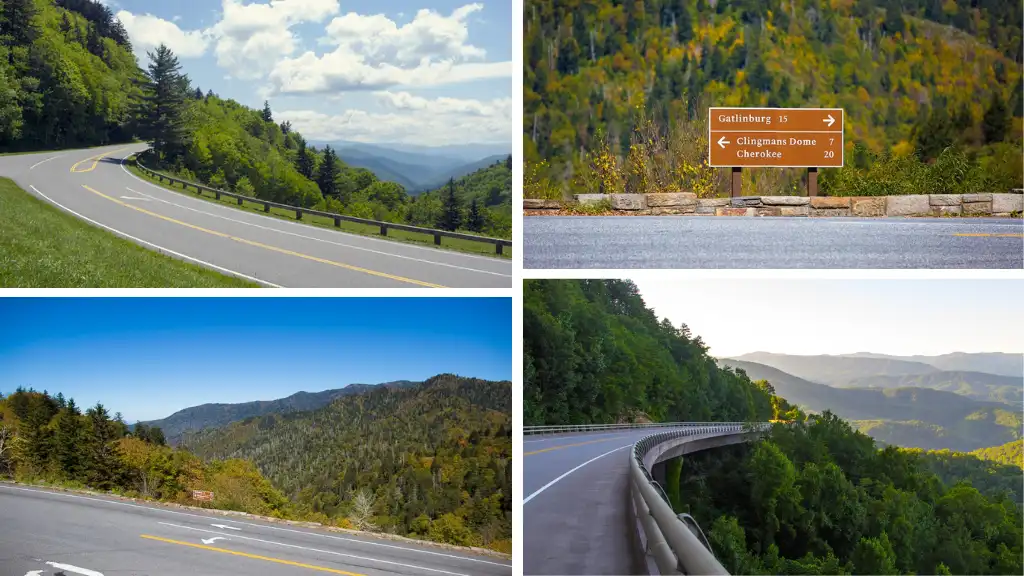
Distance: 33 miles one way | Drive Time: 1–1.5 hours without stops | Open: Year-round
If someone asks you what the most scenic drive in the Smoky Mountains is, this is the answer. It’s not even close.
Newfound Gap Road (US-441) is widely considered the most scenic drive in Great Smoky Mountains National Park. It crosses the entire park from Gatlinburg, Tennessee to Cherokee, North Carolina, climbing from about 1,300 feet to 5,046 feet at Newfound Gap. The elevation change, the forest transition from hardwoods to spruce-fir, and the views at the top make it the most complete scenic drive in the Smokies.
That 3,700-foot elevation gain isn’t just a number — you feel it. The trees change as you climb. Hardwood oaks and tulip poplars give way to darker, older-feeling spruce and fir forests that smell like Christmas and cold air and something you can’t quite name. The road gets narrower. The curves get tighter. And then you reach Newfound Gap and the whole world opens up.
Standing at 5,046 feet on the Tennessee–North Carolina border, you can put one foot in each state at the Rockefeller Memorial — where FDR officially dedicated the park in 1940. On clear days, views stretch 100 miles in multiple directions.
🌅 For the ultimate experience, drive this road at sunrise from the Gatlinburg side. The valley is full of mist at that hour, and you climb above it. You’re in the clouds, then above them, then the summit clears and the whole Appalachian range glows orange in the first light. Campbell Overlook and Morton Overlook — both roadside pull-offs — are legendary for this.
🌴 Key stops along Newfound Gap Road:
- Sugarlands Visitor Center at the Gatlinburg entrance — pick up your parking tag here
- Campbell Overlook — best sunrise view on the Tennessee side
- Alum Cave Trail — trailhead access to one of the park’s best hikes
- Morton Overlook — widely considered the best sunset spot on the road
- Newfound Gap and the Rockefeller Memorial — the summit, the state line, the view
📍 Plan your Newfound Gap Road drive at the official NPS site – Click Here
Drive 2: 🌿 Cades Cove Loop Road — Wildlife, History, and the Valley That Stops Time
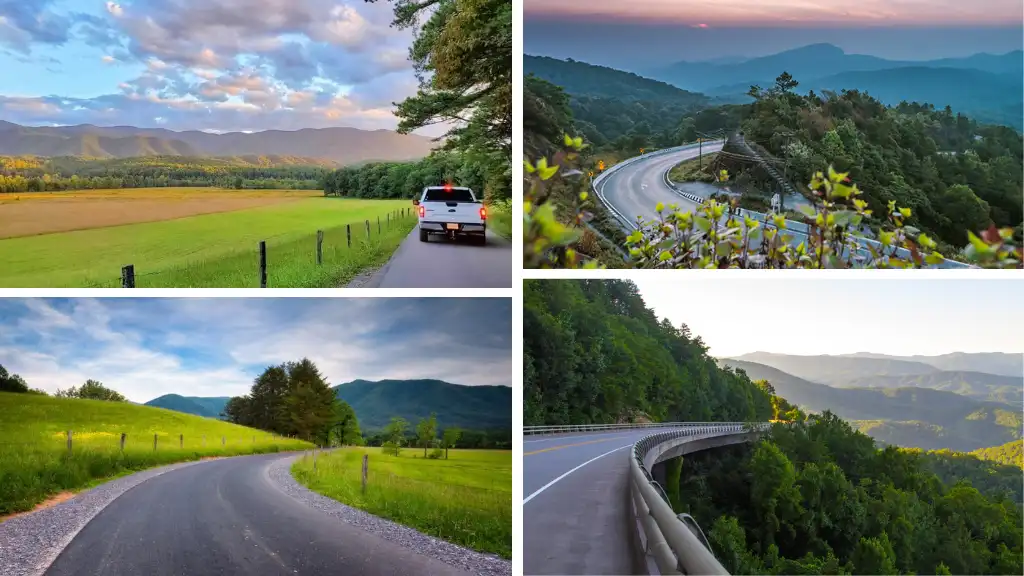
Distance: 11 miles (one-way loop) | Drive Time: 2–4 hours with stops | Open: Year-round
The Cades Cove Loop Road is by far the most popular scenic drive in the Smoky Mountains. This 11-mile, one-way road takes visitors on a journey through one of the most beautiful places in the park.
Popular doesn’t mean overrated. Cades Cove earns it, and it earns it differently than Newfound Gap Road. Where Newfound Gap delivers elevation drama and long-range mountain vistas, Cades Cove gives you something more grounded and more emotional — a valley that feels like it’s been holding its breath since the 19th century.
The cove is a broad, flat valley surrounded by forested ridges on all sides, forming a natural amphitheater that was once Cherokee hunting ground and later a tight-knit Appalachian farming community. Three 19th-century churches, multiple log cabins, a working grist mill, a cantilever barn, and a smokehouse still stand along the loop, each one preserved exactly where the families who built them left them when the park was established in 1934.
The valley is surrounded by mountains on all sides, creating a natural amphitheater of stunning beauty. This is widely considered the best place in the park for wildlife viewing, with black bears, white-tailed deer, wild turkeys, and coyotes regularly spotted in the open meadows.
You don’t rush Cades Cove. You can’t. And eventually, you stop trying.
🌴 Wednesday morning in summer: Wednesdays are vehicle-free in 2026 — perfect for biking. The loop road closes to cars on Wednesday mornings from mid-June through late September, opening it exclusively to cyclists and pedestrians. Bear sightings on these quiet mornings are remarkably frequent. Bike rentals are available at the loop entrance.
📍 Practical tip: Arrive before 8 AM on any day to beat traffic and catch wildlife in the early morning meadow light. The difference between arriving at 7 AM versus 11 AM is the difference between a peaceful valley experience and sitting in a mile-long car queue.
📍 Plan your Cades Cove Loop visit at the NPS page – Official Website
Drive 3: 🌊 Roaring Fork Motor Nature Trail — Old-Growth Forest, Waterfalls, and Zero Pretense
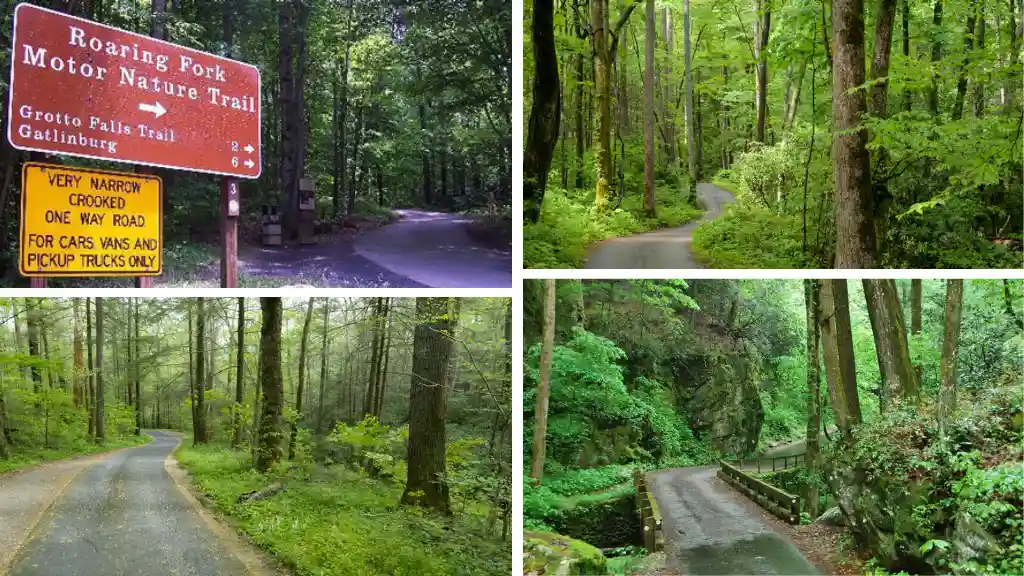
Distance: 5.5 miles (one-way loop) | Drive Time: 1–3 hours with stops | Open: Mid-April through late November
If Newfound Gap Road is the Smokies’ headline act and Cades Cove is its emotional center, Roaring Fork is the one that surprises you.
The Roaring Fork Motor Nature Trail is the best for old-growth forest and historic cabins. It starts in downtown Gatlinburg — turn at traffic light #8 onto Historic Nature Trail, then follow signs to Cherokee Orchard Road — and within minutes you’re swallowed up by ancient hemlock and tulip poplar so dense the road narrows to a single lane and the sky almost disappears above the canopy.
This drive is especially beautiful after a heavy rain because of the Roaring Fork stream you’re driving alongside. Keep an eye on the trees as you drive through — that’s where black bears can often be spotted.
The road passes the Ogle Place homestead — a stone chimney and log cabin that sit exactly where a family once farmed this steep mountain slope by hand in the 1800s — and provides trailhead access to two of the park’s best waterfall hikes: Grotto Falls (where the trail goes behind the waterfall) and Rainbow Falls (the park’s tallest single-drop waterfall at 80 feet).
🍹 After the drive, head back to downtown Gatlinburg and grab a post-forest cold drink at Smoky Mountain Brewery on the Parkway (smokymtnbrewery.com). Their Mountain Light Lager was made for exactly this kind of afternoon.
⚠️ Important restrictions: Buses, RVs, trailers, and large vehicles are NOT permitted on Roaring Fork. The road closes in late November and reopens in mid-April. The 5.5-mile, one-way Roaring Fork Motor Nature Trail takes about 1 hour without stops — plan 2 to 3 hours if you stop at the waterfalls and historic cabins.
📍 Get Roaring Fork access details from the NPS – Official Website
Also Read:- 9 Incredible Things to Do at Great Smoky Mountains Park with Family — 2026 Adventure Guide
Drive 4: 🌴 Little River Road — The Riverside Drive That Connects Everything
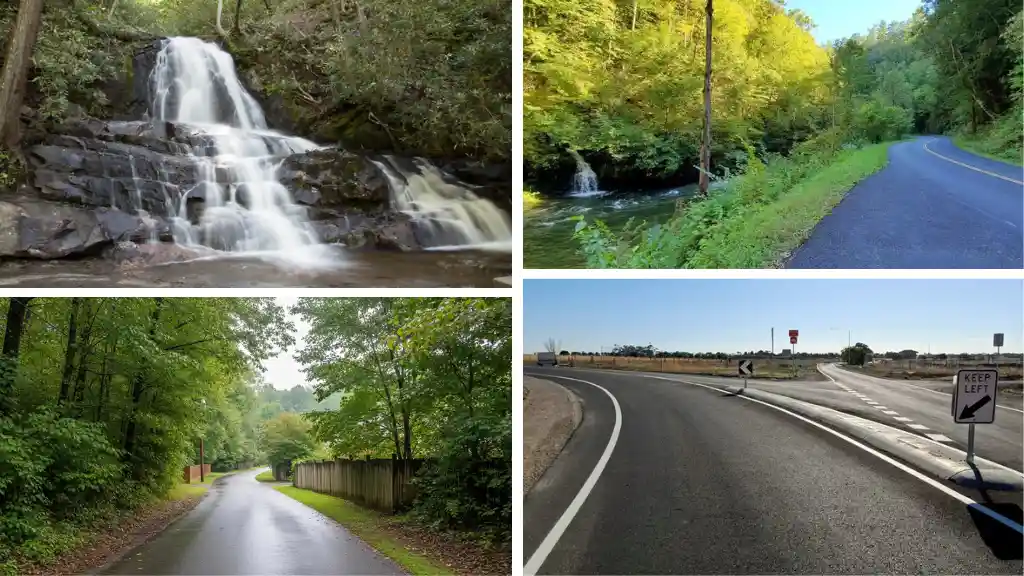
Distance: 18 miles | Drive Time: 45 minutes without stops, 2+ hours with stops | Open: Year-round
Here’s the scenic drive that Smoky Mountains veterans tend to love most — and first-time visitors often overlook entirely because it doesn’t have the same marketing weight as Cades Cove or Newfound Gap Road.
Little River Road is an 18-mile riverside drive that connects Gatlinburg to Townsend, winding past waterfalls, picnic areas, and trailheads. It’s a favorite for fall color and easy access to water features.
The road runs parallel to the Little River for most of its length — and that river is one of the most visually satisfying things in the entire park. It tumbles over smooth boulders, widens into clear green pools deep enough to swim in during summer, and narrows back into rushing whitewater around every bend.
This is a road that rewards driving at 20 mph with the windows down. You’ll hear the river before you see it around most corners.
🌊 Key stops on Little River Road:
- The Sinks — a dramatic waterfall and deep pool about 12 miles in, accessible from the road with a short walk
- Meigs Falls — visible directly from the car at a stone-walled pull-off; many people drive right past it
- Metcalf Bottoms Picnic Area — a shaded riverside picnic ground that’s genuinely perfect for lunch
- Townsend Wye — the junction where Little River Road meets Laurel Creek Road toward Cades Cove; great swimming hole access
Combining Newfound Gap as the main drive with Little River Road as the return route covers most of what the park offers in a single day. Many seasoned visitors do exactly this — up through the park on Newfound Gap Road, across to Cherokee, then back via I-40 and into the park again from the Townsend side on Little River Road. One full loop, every biome, every ecosystem, and at least three stops worth stretching your legs for.
📍 Check Little River Road conditions at the NPS site – Official Website Here
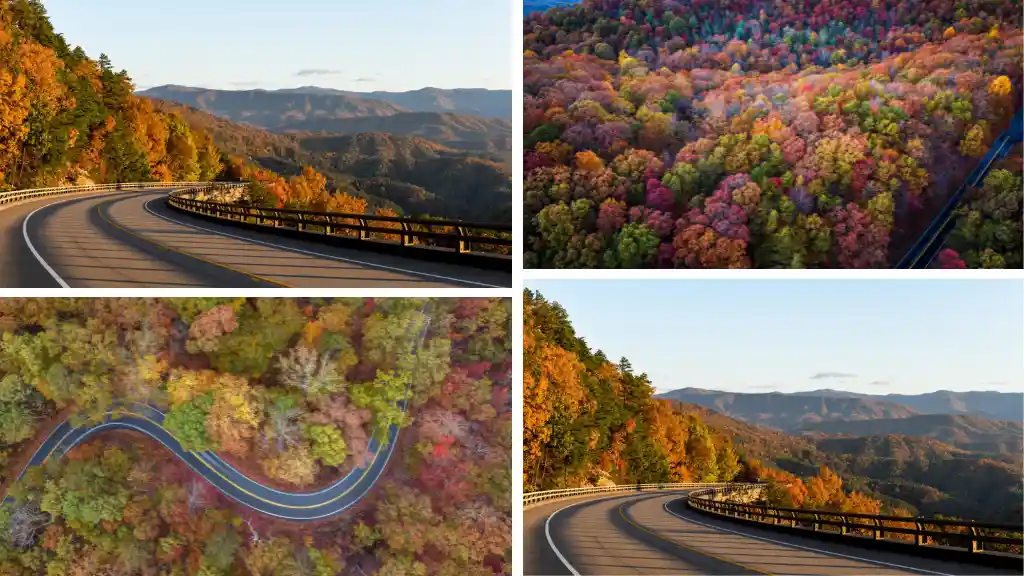
Drive 5: 🏞️ Foothills Parkway — The Hidden Panorama Almost Nobody Talks About
Distance: 72.1 miles total (drive the “Missing Link” 16-mile section for the best views) | Drive Time: 45 minutes for the Missing Link, without stops | Open: Year-round
Every list of the 5 most scenic drives in the Smoky Mountains that will leave you speechless needs one outlier — the drive that regulars know about and newcomers discover by accident. The Foothills Parkway is that drive.
The Foothills Parkway is widely considered the most scenic drive in the Smoky Mountains. It offers panoramic mountain views, fewer crowds than the national park, and multiple scenic overlooks perfect for photos.
What makes it different from the other four drives is perspective. Instead of being inside the forest, you’re above it — driving along a high ridge with unobstructed views of the Smokies stretching south and the Tennessee Valley spreading north. The mountains are in front of you the whole time. You’re not moving through them. You’re watching them from the outside.
The 72.1-mile parkway connects US Route 129 along the Little Tennessee River in the west with Interstate 40 along the Pigeon River in the east. Large sections cross a series of high ridges running roughly parallel to the Tennessee boundary of Great Smoky Mountains National Park and offer unobstructed views of the Smokies to the south and the Tennessee Valley to the north. This section is known as the “Missing Link” and stretches 16 miles featuring breathtaking views with multiple overlooks to take photos and enjoy the scenery.
The Missing Link section — finally completed and opened in late 2018 after being under construction since 1944 — is the absolute highlight. Drive it at sunset and you’ll see why people come back to this ridge year after year. The light goes gold. The mountain silhouettes stack into the distance. The Tennessee Valley below catches the last glow.
🌅 Local tip: Drive the Missing Link section westward in the late afternoon so you’re heading toward the sunset the entire time. The overlooks face west and southwest — built for exactly this.
📍 Get Foothills Parkway information from the NPS – Official Website
What Is the Most Scenic Part of the Smoky Mountains?
The honest answer depends on what moves you.
For raw elevation drama and the feeling of truly crossing a mountain range, Newfound Gap Road at sunrise or sunset is unmatched. For emotional depth and wildlife, Cades Cove in the early morning is the peak experience. For sheer panoramic beauty with minimal effort, the Foothills Parkway Missing Link delivers views that few people expect and almost everyone remembers.
The most photographed single spot in the park is arguably Morton Overlook on Newfound Gap Road — a pull-off on the Tennessee side that frames the mountain ridges in a way that looks designed rather than natural. It’s particularly extraordinary at dusk when the mist fills the valleys below and the ridgeline goes purple against a darkening sky.
Also Read: Need a Great Smoky Mountains Parking Pass? Buy It Online in Minutes
How Long Does It Take to Drive Through the Great Smoky Mountains?
Great Smoky Mountains National Park has several roads open to private vehicles year-round, including Newfound Gap Road (US-441), which crosses the entire park from Gatlinburg, Tennessee to Cherokee, North Carolina.
The straight drive from Gatlinburg to Cherokee on Newfound Gap Road — without any stops — takes roughly 50 minutes to 1.5 hours depending on traffic and season. With stops at overlooks, visitor centers, and the Newfound Gap summit, plan on 2.5 to 3 hours minimum.
For the biggest geographic range in a single trip, combining Newfound Gap as the main drive with Little River Road as the return route covers most of what the park offers in a single day.
If you’re planning a proper two-day scenic drive experience, day one covers Newfound Gap Road and Roaring Fork, and day two takes on Cades Cove Loop and Little River Road — giving you the full range of ecosystems, elevations, and emotional registers the park offers.
What Is the Best Month to Go to the Smoky Mountains?
Every season makes a real argument here, and the honest answer is that it depends on what you’re after:
🌿 April and May deliver spring wildflowers across the lower elevations and waterfalls running full from snowmelt. The forest is bright and green, the roads are open, and the crowds are manageable before Memorial Day.
☀️ June through August means all roads are open, all trails are accessible, and the elevation of Newfound Gap Road keeps it cooler than the valleys even in July. Cades Cove gets crowded by mid-morning — go before 8 AM.
🍂 October is the consensus favorite, and with good reason. Fall foliage along this drive is legendary, with peak color typically occurring from mid-October at the highest elevations to early November at lower elevations. The ridge system goes amber, gold, scarlet, and rust. Every overlook on Newfound Gap Road looks like someone curated it. Weekends in October are extremely busy — go on weekdays if you can.
❄️ November through March brings genuine quiet. Crowds thin dramatically, Cades Cove has a haunting, dormant-season beauty, and light snow on the upper elevations of Newfound Gap Road creates conditions that most visitors never see. Kuwohi Road closes in December, but everything else stays open.
Is It Better to Go to Pigeon Forge or Gatlinburg?
This question comes up constantly, and the answer genuinely depends on what your trip looks like.
Gatlinburg sits directly at the main Tennessee entrance to the park — just minutes from the Sugarlands Visitor Center, the Roaring Fork trailhead, and Newfound Gap Road. It’s smaller, quieter (relatively speaking), and more directly connected to the park experience. The downtown Parkway has restaurants, shops, and bars within walking distance of the park entrance.
Pigeon Forge sits about 8 miles north of Gatlinburg and leans much more heavily into entertainment and family attractions — Dollywood is here, as is the Island complex with rides and restaurants, plus outlet shopping and Titanic attractions. It’s louder, flashier, and gives families with younger kids more options outside of the park.
For the 5 most scenic drives in the Smoky Mountains, Gatlinburg is the better base. It puts you closer to every trailhead and road entrance, and you spend less time in car traffic between your accommodations and the park itself.
For families who want equal parts park and entertainment, splitting time between both towns — or basing in one and day-tripping to the other — is the standard move.
What Town Is Closest to the Great Smoky Mountains?
Gatlinburg, Tennessee is the closest town to the park’s main entrance — the Sugarlands Visitor Center sits essentially at the edge of downtown Gatlinburg. The drive from Gatlinburg’s main Parkway intersection to the visitor center takes under five minutes.
On the North Carolina side, Cherokee, NC sits at the park’s southern entrance — about 2 miles from the Oconaluftee Visitor Center, which is the starting point for the Mountain Farm Museum and the Mingus Mill historic site.
For visitors approaching from the southwest, Townsend, Tennessee — sometimes called the “Peaceful Side of the Smokies” — is the quietest and least-trafficked gateway, giving you direct access to Little River Road, Cades Cove, and the Foothills Parkway with almost none of the commercial strip that Gatlinburg and Pigeon Forge carry.
After the Drives: Food, Vibes, and Gatlinburg After Dark
You’ve done the roads. You’ve seen the views. You’re back in town with tired legs, full eyes, and an honest appetite.
🍹 The Peddler Steakhouse (Official Website) is the Gatlinburg institution — a wood-paneled restaurant built on stilts over a mountain stream, open since 1976, where you choose your own cut and the salad bar is a local legend. If you’re celebrating — a birthday, an anniversary, the fact that you actually went on this trip — this is where you celebrate.
🌊 Smoky Mountain Brewery (Official Website) on the Parkway is the move for a casual evening with good local craft beer and mountain pub food. The Mountain Light Lager is cold, light, and exactly right after a day on the road.
🌴 Ole Smoky Distillery (Official Website) on the Gatlinburg Parkway does moonshine tastings in a barn-style space that absolutely delivers on atmosphere. Not a chain, not a gimmick — this is a genuine Tennessee distillery doing legitimate craft moonshine and whiskey with free tastings. The Blackberry Moonshine is something you bring home in your luggage.
For the late-night crowd, The Strip in downtown Gatlinburg stays lively well into the evening with street performers, fudge shops that are inexplicably still open at 10 PM, and the kind of warm, kitschy charm that’s deeply specific to this part of Appalachia.
A Note About the 49-Mile Scenic Drive
Several visitors ask about a “49-mile scenic drive” in the Smokies — a reference to a combined auto tour route that links Newfound Gap Road, Little River Road, and Cades Cove Loop into one continuous driving circuit through the park. It’s approximately 49 miles total and represents the best single-day scenic drive loop available in the park, hitting all the major ecosystems and attraction points without backtracking.
There’s no official park designation for this loop, but the route is: start at Sugarlands Visitor Center → drive Newfound Gap Road to Newfound Gap → return to Gatlinburg → take Little River Road west to Cades Cove → drive the Cades Cove Loop → exit via Laurel Creek Road back to Townsend → return via US-321 to Gatlinburg.
Plan a full day. Start early. Bring snacks, water, and a fully charged camera.
Conclusion: Some Roads Give You More Than the Destination
The thing about the 5 most scenic drives in the Smoky Mountains is that they’re not really about getting somewhere. Newfound Gap Road doesn’t get you to anything you couldn’t also reach by helicopter. Cades Cove Loop ends where it begins. Roaring Fork circles back to Gatlinburg.
The drives are the point.
They exist to slow you down inside a place that doesn’t need anything added to it. These mountains have been here since before most of Earth’s current mountain ranges existed. The mist that gives them their name rises from billions of trees doing what they’ve always done. The bears in Cades Cove have never once needed a visitor to complete their day.
You show up. You drive slowly. You look out the window. And somewhere between one overlook and the next, the mountains do what they’ve always done to everyone who comes here and actually pays attention.
They leave you speechless.
FAQs: Scenic Drives in the Smoky Mountains
What is the most scenic drive in the Smoky Mountains?
Newfound Gap Road (US-441) is the most iconic and complete scenic drive — 33 miles from Gatlinburg to Cherokee, climbing from 1,300 feet to 5,046 feet at the summit. For panoramic open views with fewer crowds, the Foothills Parkway’s Missing Link section is equally stunning and dramatically underrated.
Is there a fee to drive the scenic roads in the Smoky Mountains?
No entrance fee for the park. A parking tag ($5/day or $15/week) is required if you stop for more than 15 minutes at most pull-offs and trailheads. Purchase at any visitor center or at nps.gov/grsm.
When does the Roaring Fork Motor Nature Trail close?
Roaring Fork closes in late November and reopens in mid-April each year. It’s also not accessible to buses, RVs, trailers, or large vehicles at any time of year. Check nps.gov/grsm for current road status before visiting.
Can I drive all 5 scenic routes in one day?
Technically yes — but you’d be rushing all of them. A better approach: Newfound Gap Road and Roaring Fork on day one, Little River Road and Cades Cove on day two, and the Foothills Parkway as a sunset drive on either evening. That rhythm gives each road the time it deserves.